L.REV
说明
翻转(Reverse)
在源操作数的每个 M 位范围内以 N 位为单位进行高低位翻转,结果写到目的寄存器中。
汇编语法
汇编符号
- SrcL:源寄存器,可以索引的寄存器类型请见长指令介绍。
- T:指定操作数的数据类型,可选参数根据寄存器类型不同而有所区别。
- M:表示每次进行翻转操作的操作域位宽,合法取值包括:{2, 4, 8, 16, 32, 64}。该参数减1后编码于immr字段。
- N:表示每个操作域内进行翻转操作的单位,合法取值包括:{1, 2, 4, 8, 16, 32}。该参数编码于imml字段。
- ->:用于指示目的寄存器。
- RegDst: 目的寄存器,可以索引T/U或P类型标量寄存器。
- d:目的寄存器的位宽标识(d表示64-bit)。
如果源寄存器是向量寄存器,那么目的寄存器最终写入的值由实现定义。
注意事项!
M和N的取值必须小于源寄存器位宽,否则硬件执行结果不可知。
编码格式
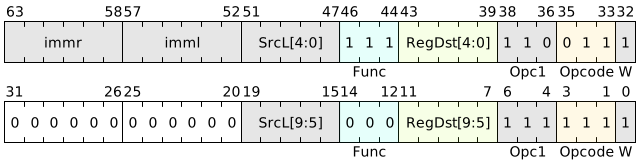
寄存器字段的编解码方式请见长指令编码小节。
执行方式
    integer {m, srcWidth}  = DecodeINT(SrcL);
    integer {d, dstWidth} = DecodeDst(RegDst);
    integer M = UInt(immr) + 1;
    integer N = UInt(imml);

    // 以下情况报非法指令
    if M isnot in range{2, 4, 8, 16, 32, 64} then Exception(EC_ILLEGAL);
    if N isnot in range{1, 2, 4, 8, 16, 32}  then Exception(EC_ILLEGAL);
    if M <= N                                then Exception(EC_ILLEGAL);

    bits(srcWidth) operand = SREG[m, srcWidth];
    bits(dstWidth) result;

    integer fieldnum = 64 / M;
    integer elementnum = M / N;
    integer idx = 0;
    integer ridx;
    for i = 0 to (fieldnum - 1) {
        ridx = idx + (elementnum - 1) * N;
        for j = 0 to (elementnum - 1) {
            result[ridx+(N-1): ridx] = operand[idx+(N-1) : idx];
            idx += N;
            ridx -= N;
        }
    }

    SREG[d, dstWidth] = result;